If so, here is the scoop from a very successful Illustrator Yuko Shimizu who rocks the Magazine, Newspaper, Album Covers, Book Jackets and of course Comic Book Illustration world. In this video she covers her education, work, and how she got started in illustration. She tells interesting stories about various projects she’s worked on. She is very humble and makes a good case for starting a career later in life. (She didn’t start when she was 20). Her first job was in marketing and she said when noticed that the people around her that had been in the field for many years didn’t look happy. She also makes a case for the idea that you shouldn’t be worried if your work isn’t brilliant first time out. The video is a little over an hour but very much worth your time. She is optimistic about the future of magazines and other “tangible” forms of journalism.
BONUS she is a fellow alumni of School of Visual Arts and she is very entertaining to listen to – kinda like the Saturday Night Live Asian lady in a very charming and endearing way!
This is a great cause and a great organization – I really hope that a lot of graphic designers and fashion designers will participate. You have a chance to win $3,000.00 as the first prize but more importantly than that you will be supporting a great cause, helping the textile industry in Bangladesh. (It's ironic that I posted a Beatles video "Lucy In The Sky with Diamonds" on facebook today before I found out about this opportunity — you may know that the Beatles were big supporters of Bangladesh) They wrote a song called "Bangladesh" to raise awareness about living conditions there. And there is a documentary about their efforts called "Concert for Bangladesh".
Design 21 is an awesome non-profit organization – if you are a finalist your work will be displayed on their site as well. Just click below for details.
Call For Entries "WEAVING LOVE, CREATING HOPE"
Create a symbol of "Hope" for a local textile industry in Bangladesh
I came across a blog post by Michael Johnson and could not pass up reposting it. It reviews the latest book by Malcom Gladwell best selling author of "Blink" and "The Tipping Point". It supports the point that "genius isn’t necessarily born, but cultivated by circumstance, luck and good old-fashioned hard graft…" He sites the careers of Bill Gates, the Beatles, Wolff and Olins and others to compare the qualities that successful people have in common.
But the thing I found most interesting is that he recognizes that in this fast paced – gotta have it now world – Graphic Designers emerging from art schools will find the point that it may take 10,000 hours before they start producing notworthy work hard to swallow. I can attest to this because I teach young emerging graphic designers. Here is the link: 10,000 hours of graphic design? – the johnson banks thought for the week.
Steve Jobs Talks About The Three Things to do Before You Die
Post Script: I toyed with taking this post down, but I think the message is something that Jobs left as part of his legacy… I wanted to pass this video along from Steven Jobs about connecting the dots along your life’s path and how typography changed the world.
Tim Ferriss Talks About How to Make Your Company Sellable
I know that this may be a bit premature or most of you, since my readers are typically fledgling entrepreneurs developing their dream into a real flesh and blood company, but I am intrigued by this fellow and decided to re-blog one of his posts about selling one of his companies.
It’s something to think about, because it very well may happen to you when you accomplish your goals of building a business the is successful. What I got from it was, he was willing to take less money for more freedom meaning, less personal obligations or strings related to the deal.
“Didn’t you write that you believed BrainQUICKEN couldn’t be sold?” The question — a common one — was from writer John Warrillow and for an article in Inc. Magazine. The embarrassing answer was “yes.”
In 2005, I had assumed it was impossible to sell my then start-up and, as with most assumptions, I was dead wrong. I sold BrainQUICKEN in 2009 and learned volumes in the process. For example: counter to expectations, I ended up caring more about lack of strings than maximizing price… Several chess moves into price negotiation, after the suitor and I had arrived within 10% of each other, I offered to reduce the asking price 20% in exchange for the elimination of most “reps and warranties.” This would give me a clean break, financially and emotionally, and it would dramatically speed up the sales process.
I don’t regret that apparent “concession” and would make the same decision in a heartbeat. If I’d been tied to the business, I doubt The 4-Hour Body would have been written. Lessons learned, part deux: branding and customer databases are sometimes worth as much as defensible “hard” intellectual property. This realization eluded me for years, and in retrospect, it was ridiculous self-denial. Trademarks and distribution relationships can be sold at a handsome profit, both of which I’d undervalued, blinded by my own hands-in-the-air resignation related to lack of patents. Silly rabbit.”
Russel Simmons – Vision of a Successful Entreprenuer
I wanted to launch this page with a profile of one of my favorite entrepreneurs alive today. I picked Russel Simmons because he has made his fortune leveraging the talents of under-represented creative individuals to launch lucrative enterprises such as Def Jam and Phat Farm. I love his philosophy of supporting up-and- coming creative talent; helping others to succeed and in turn becoming more successful himself. Simmons see opprortunities that others are blind to.
“Simmons says he simply gives an untapped market what it wants when no one else will. “No one wanted to make a movie about rap, so I had to make a movie,” he says, referring to 1985’s “Krush Groove,” which he co-produced. “I couldn’t find anyone to do fashion design with, so I had to start a fashion design company. I’m a servant to the hip-hop community. That’s basically the way these entrepreneurial things become expressed. You’d be happy to work with somebody, but nobody wanted to work with you.”
How did he do it? Here is a list of: Russell Simmons’ best moves By Kristin Ladd
1978 As a sociology student at CCNY, Simmons begins promoting rap acts and managing Curtis Walker (aka Kurtis Blow).
1979 Quits school and launches Rush Productions.
1982 Signs his little brother, Joey (aka Rev. Run), and unleashes Run-DMC’s monster single, “It’s Like That,” in 1983.
1984 Creates the Def Jam record label with producer Rick Rubin. The next year, a CBS distribution deal makes Def Jam the largest rap label in history; the roster now includes Slick Rick, Public Enemy, the Beastie Boys, EPMD, 3rd Bass and Onyx.
1991 Debuts Russell Simmons’ Def Comedy Jam on HBO. Over seven seasons, it becomes a showcase for black comedy stars including Martin Lawrence, Chris Rock, Jamie Foxx, Bernie Mac, Cedric the Entertainer, D.L. Hughley, Steve Harvey and Chris Tucker.
1993 Unveils a men’s clothing line, Phat Farm, which later generates a women’s line, Baby Phat. Will sell both labels for $114 million in 2004
1996 Produces Eddie Murphy’s comeback film, The Nutty Professor, grossing over $273 million in sales worldwide. .
1999 Before the music industry collapses, sells the last of his shares of Def Jam for $100 million to the Universal Music Group. Stays on as a titular chairman.
2001 Russell Simmons’ Def Poetry Jam debuts on HBO. Becomes co-chairman of the Hip-Hop Summit Action Network, a philanthropic group focused on educational projects and social change.
2005 Teams up with Unifund Corp. to launch UniRush Financial Services and the Rush Visa card. UniRush now has revenues of more than $1 billion a year.
2008 Creates Global Grind, a hip-hop blogging site with a political edge and 40 million fans.
2008-09 Launches Argyle Culture, a men’s clothing line at Macy’s. Follows up with a more affordable preppy knockoff, American Classic for Wal-Mart. Envisions its future as “”huge.”
The Business of Selling Your Creative Ideas and Products
This section of my blog will deal with providing resources on the subject of selling creative products and services.
More and more artists and designers in this digital age are becoming entrepreneurs and I don’t mean only by opening their own design studio. The resources are now available to easily and inexpensively self-publish. Many run successful blogging businesses where they share design resources and teach design tricks and tips. And, it is not very difficult to get products manufactured (overseas and at home) using a “just in time” business model, meaning producing the product after the sale is made. But unfortunately only a few creative schools are offering an education in entrepreneurship. Most people are getting their education in the forums of sites like Etsy.com, an online marketplace to sell all things handmade. Etsy is all about how to quit your day job and open yor own business.
There is (of course) a lot to it aside from having the talent is takes to come up with an idea or create a product. Remember the four “p”s of marketing. I’ll cover more on these in later posts.
product
place
price
promote
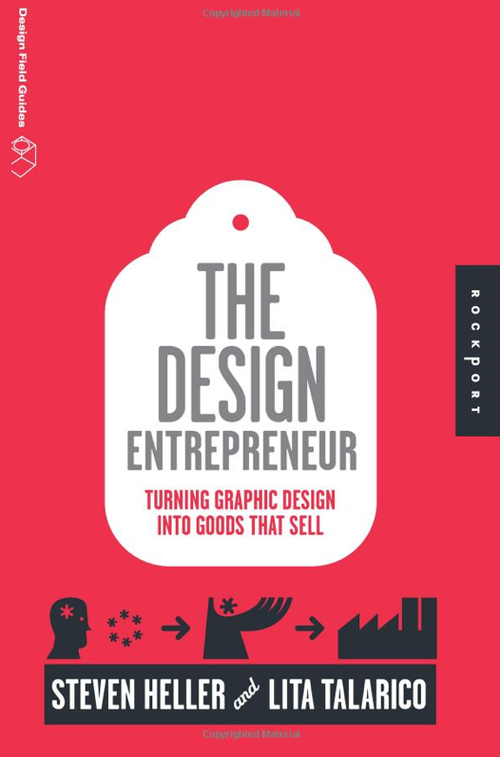
There have been a couple of books published on the subject of Design Entrepreneurs by Steven Heller. In the first book “The Education of the Design Entrepreneur”, Heller asks “… your not just a designer anymore are you?” This makes me feel a little better since I have been criticized by a few of my fellow artists “as selling out” since I opted for an MBA degree over an MFA degree. But gloating aside, I think this is a subject that will be of interest to many and I hope to learn a lot myself in doing the research. In addition to getting the scoop from people in the creative industries, I plan to feature some very successful entrepreneurs who are not artist per se. My next post will be on Russell Simmons.
Also, I recommend reading INC magazine and you guessed it — Entrepreneur magazine. There are great articles available both online and in print.
Brand Yourself Like a Rockstar
I found a great resource I wanted to share with the class regarding applying branding principles to marketing yourself or your personal brand. Read the article below for the principles that apply to both branding individuals and branding comapnies. Also download a free PDF titled:
by Rockable Press or click on the right sidebar for more tutorials and tips and tricks from Rockable Press.
The Secret Behind Justin Bieber’s Brand Success –
Here a great article from Forbes Magazine writer Adam Allenson (image via Wikipedi)
As most in the movie theater for the showing of the documentary “Never Say Never” (including my 8-year-old daughter), watched in awe as its subject, Justin Bieber, flipped that wonderful hair off his wonderfully cherubic face, I watched in awe as his first-class management team, including Usher and Scooter Braun, skillfully carried out the tenets of Branding 101. It’ s not without good reason that this flop-top-pop star has become the successful brand he has, the reason or, rather, reasons, being as follows.
1. Overnight never happens overnight. While it may seem that Justin Bieber and any number of other strong brands magically appear overnight, this is not the case. It takes laser focus on a clear objective delivered consistently and with due diligence over a period of time to win hearts and minds, especially in this very competitive, noisy marketplace. Justin did his time playing in shopping malls and in parking lots from Cleveland to Syracuse, and visiting radio station after radio station with his finely tuned act, all while remaining conscientiously attentive to his musical concept. Brands that succeed, be it an Apple or a Jet Blue, a Boyz II Men or a Bieber, ensure they stick to the basics, do the basics well and never veer from what they want to stand for in the minds of consumers.
2. No detail is too small The experience–and reputation–of a brand is the sum of its parts, no matter how big or small this part may be. Even with its breadth and depth of inventory, Zappos wouldn’t be Zappos without the quick and friendly e-mail follow-up or its super easy return process. Be it his vocal coaching, his hair stylist, his back-up singers or his choice of public relations initiatives, those in charge of the Justin Bieber brand, including Justin himself, know that one inauthentic move, one missed detail, one non-Bieber incident, could make non-Beliebers out of his fans
3. Tell your own story If you don’t say it, who will? Except maybe the millions of people on YouTube or with Twitter accounts. The best brands grab hold of the message they want to communicate and they communicate it in a style commensurate with the image they want to evoke. Take Unilever’s Dove brand, for instance. Starting with its brilliant “Evolution” video, in which a lovely young women is morphed into a stunning, but unrecognizable version of herself by means of make-up and heavy photo-shopping, the Dove brand team continues to build on its idea that every woman deserves to feel beautiful just the way she is. It’s a campaign that’s lasted and, more important, outlasted its many online parodies. “Never Say Never” was a brilliant way for the Bieber brand team to tell its story and, just as brilliantly, get it out there when the media wind was at its back. When you’re on a roll, do what you can to keep the momentum going.
4. Keep good company Or, said another way, the company you keep can help define your brand. Gatorade gets a burst of branding energy from its association with professional sports brands, and Visa, a healthy lift from being associated with the Olympics brand. These alignments are smart because they’re in line with how these brands want to be–and are–perceived. In similar spirit, Justin Bieber’s brand image gets serious street cred from his association with American recording artist, dancer, and all-around super-star Usher, not to mention the likes of Miley Cyrus, Jaden Smith and Ludacris.
5. Oh, yes. Make sure you’ve got a good product. I did say I enjoyed watching “Never Say Never,” didn’t I? And although it was partly because I appreciated the branding acumen of the Bieber team, the kid can sing. He’s personable. He’s professional. All in all, he’s good at what he does and he is what he says he is. At the end of the day, if a brand can’t deliver on expectations and do what it’s supposed to do competently, if not better than all the rest, well, it should keep its day job. Justin, in my branding book, you’re doing okay, kid.
This week in Corporate Communications we are going to focus on on original wordmark design. In order to explain the process I use, I am showing some examples of my own work and some of the inspiration resources I use. Later this week I posted the entire process in the "Classroom" section of this blog. Below are some examples of my custom wordmark work:
And now some of the images I photographed for inspiration while in New Orleans. New Orleans is one of few older cities that have made efforts to preserve their buildings and architectural heritage, including the wonderful signage. So for two years I have going there to photograph the signs of New Orleans.
Here is an example of the type of images I shoot for reference. To see more Download Images_no.
Here is another campaign that I would like my students to consider in terms of fresh identity campaign ideas and the effective use of brand touchpoints. Please compare this campaign in terms of effective communication, memorability and how well you think it connects with the target audience to the same criteria for the twitter campaign video (posted below).
Background:
"Lovells Lager was created by two successful, Australian music industry professionals, with a passion for great tasting beer….hey wanted to take the creative inspiration, craftsmanship and independence, that was the driving force of their music, and channel it into the production of their new beer. Lovells Lager was created on this very premise….Early in the process, we established the idea of disruption, as a way of acknowledging the language and expectations of established beer brands, yet putting a new twist on it. The dragon became an icon to symbolise this concept.
– Reposted from Level 11 blog please view the entire campaign there.
When tweeting about a free jewelry giveaway that I am running for Valentine's Day on Etsy I noticed that Twitter was featuring a video on their homepage about the new features coming soon!
Since we have been discussing "brand touchpoints" in my Corporate Communications class, I decided to post the video for my students to comment on. Let's see what they and you think about how effectively this video connects with the target audience.
Questions: What message was communicated and was it communicted clearly and convincingly? What did we learn here that we didn't know before about Twitter? How would you rate the video on a scale of one to ten?
As I mentioned in a previous post, my Project Study class is assigned a web project. One of our concerns will be: what makes for a website successful? I have compiled a list of web sites for my students to team up and analyze. Below are the questions I posed to them and the list of sites they are to visit. What do you think about any or all of them?
Method: Each team will be given one site to review for the class. They will post a comment and also present their views to the class. They may not all agree but that's okay, it makes for better dialogue.
Questions: Answer these questions when you comment on the site that you are assigned. Be prepared to talk about these points when your team presents:
What is the purpose of the site?
Is it well branded?
Does it evoke an emotional response?
Can you guess who their target audience is?
When you are on the site, is the "brand story" immediately clear?
Does the site do one or more of these things? Entertain, Inform, Sell.
IF YOUR NOT IN THE CLASS FEEL FREE TO PARTICIPATE! Post a comment addressing the questions listed above or add your own points. Or post a link to a website you think is great and tell us why. Let's discuss what makes a web design great.
The title does not disappoint in my opinion, David Carson walks through a visually stunning, insightful and at times very funny slide show of his work and found images; and his thoughts on intuition, psycho-killers, (how 1980's) William Burroughs, Ray Gun, Marshall Mcluhan, Nine Inch Nails, 911, Quicksilver and a lot more…
He saved the best for last at the end of the video he displays his visual genius by pointing out disturbing 911 photos juxtaposed with banal advertising in high profile magazines like Time, Newsweek and People published right after 911. "On the left we see people running for their lives and on the right we see there is a new way to support your breasts."
 If so, here is the scoop from a very successful Illustrator Yuko Shimizu who rocks the Magazine, Newspaper, Album Covers, Book Jackets and of course Comic Book Illustration world. In this video she covers her education, work, and how she got started in illustration. She tells interesting stories about various projects she’s worked on. She is very humble and makes a good case for starting a career later in life. (She didn’t start when she was 20). Her first job was in marketing and she said when noticed that the people around her that had been in the field for many years didn’t look happy. She also makes a case for the idea that you shouldn’t be worried if your work isn’t brilliant first time out. The video is a little over an hour but very much worth your time. She is optimistic about the future of magazines and other “tangible” forms of journalism.









 Synergy Creative