We Launching Entrepreneurs Again!

We are kicking off the second quarter of offering a class in Designer as Entrepreneur at Art Institute of California, San Diego and I thought a great way to start is by posting this intro video to Indie Game: the movie, an award winner at the Sundance Film Festival. By the way check out the awesome work from last quarter’s class here:Design Team 2 – Design Entrepreneur check the links on the right sidebar.

Indie Game: The Movie was one of the first feature films to be born on Kickstarter. It was funded in part by two successful crowd-funding campaigns. It premiered at the Sundance Film Festival in 2012, where it won the Best Editing Award in World Documentary Cinema and was optioned by Scott Rudin.
Copyright Basics: How to Create Your Work and Keep It, Too

Is another business taking credit for your work? Our Legal Expert shows you how to prevent this from happening to you again.

Q: I’ve started a small home-based business making customized T-shirts, menus, mouse pads and other products. I take a picture and add designs or text to it. Recently, I did some menus for a business that just wanted a few. They asked me to put my business name and telephone number on them. I delivered the menus with everything they asked for. Then they took the menus to someone else and had copies made. The person who made the copies took my name off and put their own name on them, so it looks like they made the menus. Is there anything I can do to stop this? How can I keep this from happening again?

A: No one is allowed to steal your work and put his or her name on it. These things are protected under copyright laws. To get protection for your work, you have to meet three requirements:

1. The work has to be original, although it doesn’t have to be the only one of its kind.

2. There must be something tangible to the work-it can’t just be an idea. A mouse pad, T-shirt or menu is tangible.

3. The work must be in a protected category-art, sculpture, books, music, movies, videotapes, photos, software programs or other creative materials. Your graphic designs, photos and text would definitely qualify.

Read the entire article at : http://www.entrepreneur.com/article/32006#ixzz2TTIm8OMX

Blender’s Eyewear Schools Budding Entreprenuers at AICA-SD

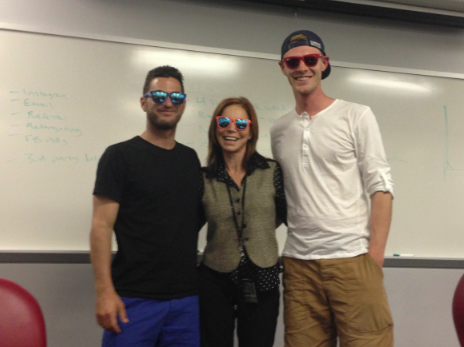
Ace of Shades Blake Jensen and his business partner Chase Fischer started Blender's Eyewear just over a year ago. Last week they visited a new class I started teaching this quarter on design entrepreneurship at the Art Institute of California-San Diego. They wanted to explain the options, challenges and advantages of starting your own business right out of college. Here is part one – note: the video was an afterthought so if you can excuse the shaky camera work on my part, I think you will find it worth watching. For more information on where to buy the sun glasses or to see their inspiring work, visit their web site: Blenders Eyewear

Aica students

Left to right: Chase Fischer, Francesca Zanuso (who helped set up the visit) and Blake Jensen

Product


Popular

LbI couldn't resist getting into the picture, I think the shades look cool on me don't you?

THE HIDDEN OPPORTUNITIES IN SIDE JOBS

As promised I will be posting resources on this blog for designers that want to create their own products/sevices and be come entreprenuers. This video on typotalks.com is a lecture by Tina Roth Eisenburg (founder of tattly.com and many other successful ventures as an entreprenuer and creative collaborater) which has lots of inspiring words and her eight rules to be a sucessfull designer/very happy person:

  • Find what You Love
  • Don't be a complainer
  • Trust your intuition
  • If an opportunity scares you take it
  • Find and connect with like-minded people
  • Collaborate
  • Ignore haters

Watch the video to see how and why these rules are good to live by:


LOOK MOM I’M TRAINING DESIGN ENTREPRENEURS

I was asked to teach a new class on Design Entrepreneurship at the Art Institue, where I am a faculty member. So I will be posting lots of resources for you creative types that wish to eighty six your day jobs and start a creative service or product business that you LOVE!

Here is the premise for class: the students will team up in groups of three or four and they will create a product that both solves a need and they will enjoy producing to sell. I can’t wait to see what they come up with – they are always amazing me with their ideas so this should really be interesting. We have had a couple of successes from me stirring the pot in my classes. First there is Sweet Bricks, a confection company that started from a class project and more recently Blender’s Eyewear, cool shades for college students at great prices. I mentioned these projects to our new academic director and the next thing I know is I’m teaching a class on entrepreneurship (insert shrill scream:0).

I have been involved in R&D and product testing for my own recent endeavers. I have had a few product launches myself with varying success. I have been truly embracing the design thinking mantra of rapid prototyping and failing OFTEN, and I have learned a lot that I will be sharing here with you and for my students. But enough about me– let’s see what we can drum up from my research. I will try to post at least once a week and maybe more often, I thought I would start with posting this video of a talk given by Kate Bingaman of Portland at the Creative Mornings event. I would love to hear what you think, so don’t hesitate to comment.

Portland/CreativeMornings – Kate Bingaman Burt from CreativeMornings/Portland on Vimeo.

BECOME A PRO PHOTOGRAPHER — USING YOUR IPHONE

Richard Koci Hernandez celebrates the art of iPhoneography—how to shoot, enhance, and share photos with an Apple iPhone. The course covers an actual iPhone photo shoot and includes details on how to select and edit photos using a variety of iOS apps and how to interact with the vibrant iPhone photo community by sharing photos using the popular Instagram app.

WHAT WE WERE BORN FOR- DESIGNERS CAN CHANGE THE WORLD

RISD’s initiative: from STEM to STEAM – in other words insert ART to add the magic

I was conducting research for my lecture tomorrow for my Design Team II class at the Art Institute and I continue to find a banquet of food for thought in Adrian Shaughnessy’s book “How To Be a Graphic Designer Without Losing Your Soul”. I assigned an excerpt from the book which discusses the qualities a young designer today must acquire and I asked the class to research a list of designers Shaughnessy mentions in the book, one of them being John Maeda (see earlier post for more inspirational designers and links to their sites).

I have been familiar with design maverick John Maeda, now president of Rhode Island School of Design (RISD), but I decided to take a look at what he is up to lately and it blew me away, take a look:

The fact that designers can bring creative innovation to the table predicts a loftly, miraculous place for young (and older) designers alike; because they can serve society and the challenges we face in the future. It makes me proud to be an designer and a design educator. Let the innovations and collaborations (the synergy of Science, Technology, Engineering, Art and Math begin!).